01 / String quartet
Amorphous
How much can change while something still seems to remain?
From the composer
Programme note.
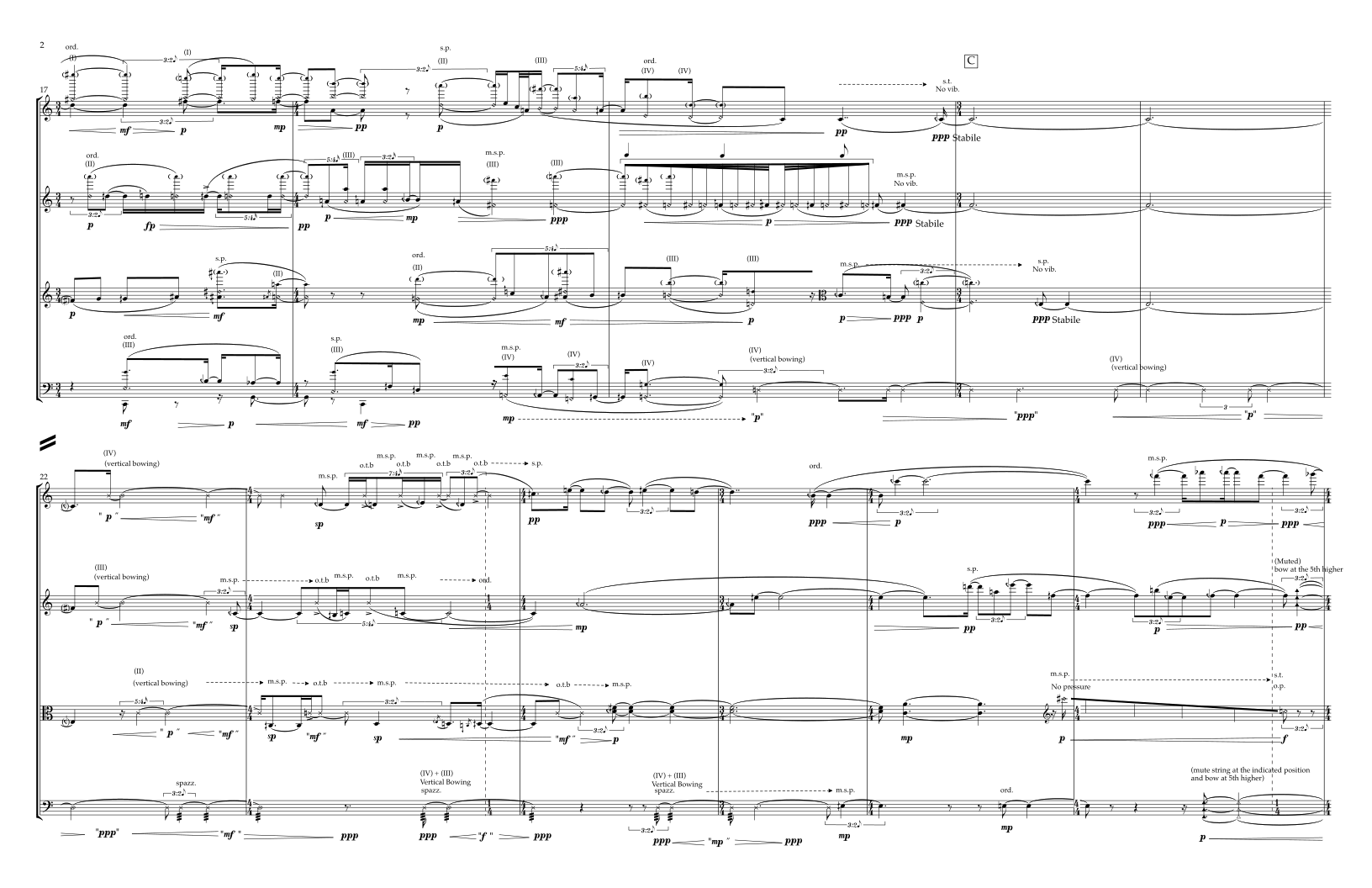
In Amorphous, I imagine the string quartet as a material whose shape never settles. Four players contribute to a shared sonority, yet their individual gestures keep disturbing its outline. The work inhabits the tension between a collective body of sound and the voices moving within it.
The bow gives this tension a physical vocabulary. Contact moves toward the fingerboard, onto the bridge and behind it; changes of pressure alter the grain of the sound. Glissandi, harmonics and microtonal inflections extend the play of unstable edges. Pitch, friction and resonance become materials through which the quartet can gather, fray and gather again.
Form emerges through changing relations between the players. More active writing gives way to sustained passages; coordinated gestures coexist with parts that move independently. I am interested in how attention might pass between an individual line and the ensemble’s larger shape: how a voice recedes into a texture, and how a small difference might bring it into focus again.
Amorphous grows from a fascination with how much can change while something still seems to remain. The score holds that question in the physical actions of four musicians; listening gives it another life.
Music, perception & neural representation
How does a sound hold together?
A quartet offers a precise starting point for auditory science: the physical sources are known, while their perceived organization can change. Research distinguishes the blending of simultaneous sounds from the linking of events over time; orchestral experiments show that timbral differences can help listeners hear separate streams. A shared musical gesture and a single perceptual source are therefore different questions. [1, 2]
Time is part of this problem. In controlled tone-detection experiments, temporal coherence and predictability in preceding sounds both influenced subsequent grouping. [3] Amorphous brings related questions into musical practice through overlapping actions, coordinated changes and sustained passages. Whether those written relations produce corresponding acoustic cues and perceptual effects requires a recording and listener measurements.
Neural representation adds another level. In a human fMRI study, variations in pitch and spectral brightness engaged largely overlapping auditory cortical regions, while multivoxel response patterns distinguished the conditions in most participants. [4] This offers a specific perspective on how different sound features can be represented within overlapping cortical territory. It does not assign a brain response to the quartet.
The next question is experimentally tractable: where do listeners report a unified texture, and where can they accurately follow a cued part? Measuring those outcomes separately would connect the compositional problem to perception. The score supplies structured contrasts; observation would establish what listeners actually hear.
This is a retrospective scientific perspective on the composition. No behavioural or neural measurements of Amorphous are reported.
My Musical Mind · 10 October 2026 · pages 1–3
Read the original presentation↗